By ResumePro™ Editorial Team. Career-search guidance reviewed against ResumePro™'s ATS scoring data and hiring-manager feedback.
ChatGPT for Resumes vs. a Purpose-Built Resume Tool
A general chatbot can write resume bullets. Here is what it cannot do — consistency, parseable export, honest scoring — and when that difference costs you interviews.
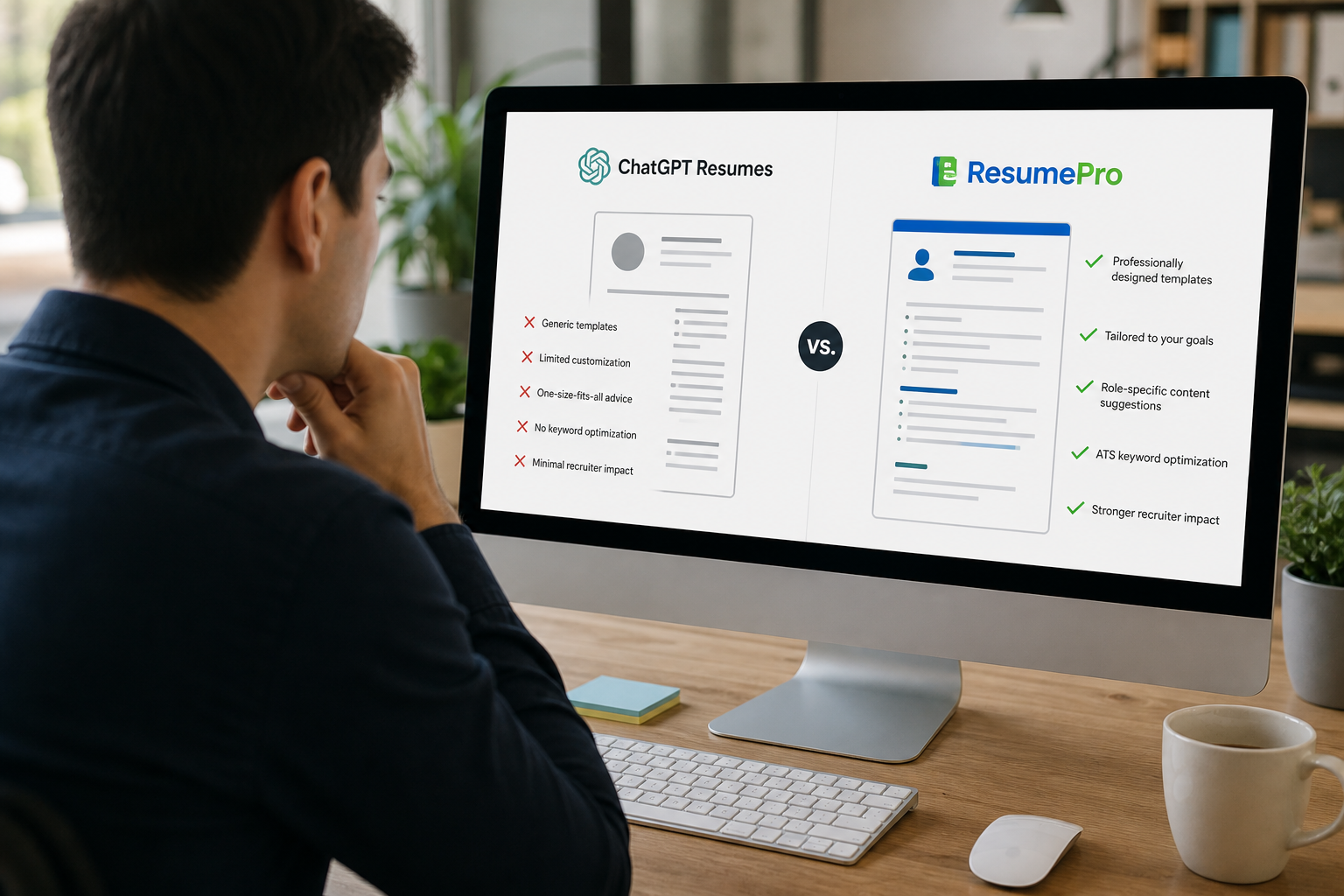
A general chatbot writes good resume bullets but has no memory of your factual backbone, no export control, and no honest scoring. Those three gaps are what cost interviews at volume.
Can you write a resume with ChatGPT? Yes, and plenty of people do it well. The gap is not writing quality — general models write clean bullets. The gap is everything around the writing: consistency across dozens of applications, a file that parses, and an honest check on whether the output is still true.
What a general chatbot does well
- Turns a duty into an accomplishment ("responsible for onboarding" becomes something with a number attached)
- Suggests stronger verbs and cuts filler
- Drafts a cover letter quickly
- Explains a job description back to you in plain terms
If you are writing one resume for one job and you are willing to edit carefully, this is a legitimate approach and it costs nothing.
Where it breaks down
1. It forgets. Across a long chat, details drift. The title you held in 2021 becomes the title you held in 2019. Team sizes change between drafts. On application twelve, you are copy-pasting from three different threads and no longer sure which version you sent where.
2. It flatters. Ask a model to make your experience sound impressive and it will. "Supported" becomes "led." "Contributed to" becomes "owned." Nothing in the interaction pushes back, and the inflation is only discovered when an interviewer asks a follow-up you cannot answer. A purpose-built tool can score overclaim risk explicitly and refuse the upgrade.
3. It has no idea what the file looks like. Chat output is text. Getting it into a document that an applicant tracking system parses correctly — single column, standard headings, embedded fonts, no text trapped in tables — is a separate job, and it is where a lot of otherwise good resumes die.
4. It doesn't score anything. You get prose, not a readout of ATS readability, role fit, or where the coverage gaps against the posting still are. You cannot tell whether draft three is better than draft two.
5. Consistency across applications. Twenty tailored resumes should share one factual backbone and differ only in emphasis. Maintained by hand in a chat window, they drift into twenty slightly different career histories — and if two of them reach the same recruiter, that is a real problem.
What a purpose-built tool adds
A resume-specific product holds your career history as structured data, so every tailored version derives from one source of truth. It orders experience newest-first and by relevance, weaves the posting's actual vocabulary into real accomplishments, scores the result and rewrites weak sections, then exports a PDF built to parse. The ATS resume checker and how it works pages walk through that.
The pragmatic answer
Use a chatbot if: you are applying to a handful of roles, you are a careful editor, and you will handle formatting yourself.
Use a purpose-built tool if: you are applying at volume, you are changing careers, you need matching cover letters, or you have been burned by a resume that "looked fine" and never got a reply. Our own tiers, including a free one, are listed on pricing.
And whichever you use — read every line and delete anything you cannot defend for ten minutes in an interview. That rule is the same for both.
Related reading: is an ATS resume checker worth it, free vs. paid resume scanners, and is tailoring your resume worth the time.
If you are shortlisting named products rather than approaches, Teal vs. Kickresume vs. AskResumePro and Resume Worded vs. AI tailoring cover the two comparisons people ask about most, and what a resume service actually costs covers the budget side before you commit.
Frequently Asked Questions
Is it bad to use ChatGPT for a resume?
No. Employers care whether the resume is accurate and relevant, not which software produced it. The risks are factual drift and exaggeration, both of which are your responsibility to catch.
Can recruiters tell a resume was AI-written?
They can often tell when it reads generically — vague superlatives, no specifics, identical phrasing to hundreds of other applications. Concrete numbers and specific systems or clients are what make it read as human.
What is the biggest risk of using a chatbot for resumes?
Quiet inflation of your role. It reads well and passes the screen, then falls apart in an interview follow-up you cannot answer.
How do you use ChatGPT to tailor a resume to a job description?
Paste your full resume and the job posting, then ask it to reorder your experience by relevance to the posting and rewrite each bullet using the posting's vocabulary, changing nothing that is not already true. Ask it to list every claim it strengthened so you can verify each one. The weakness is repeatability: the same prompt gives a different answer next time, and nothing checks the export for parseability.
What is the best ChatGPT prompt for a resume?
The most reliable prompts constrain rather than inspire: supply the resume and the posting, forbid new facts, require quantified results only where numbers already exist, and ask for a change log. Prompts that ask it to "make my resume impressive" produce the inflation that fails in interviews.
Related articles
Resume Tools
Best Resume Builder of 2026? What People Are Actually Using Now
The best resume builder in 2026 is not just a template tool. See what job seekers actually use to create ATS-ready resumes faster.
Resume Tools
Jobscan Alternatives in 2026: What to Use Instead
Jobscan popularized the resume match score. Here is how the main alternatives compare in 2026, and how to pick the one that matches how you actually apply.
Resume Tools
Teal vs. Kickresume vs. AskResumePro: Honest Comparison
Three tools, three different problems: pipeline tracking, document design, and per-job tailoring. Here is which one matches your actual bottleneck.