
By ResumePro™ Editorial Team. Career-search guidance reviewed against ResumePro™'s ATS scoring data and hiring-manager feedback.
Resume Worded vs. AI Resume Tailoring (2026 Comparison)
Resume Worded grades your resume once. An AI tailoring tool rewrites it per job posting. Here is what each one is accurate about, and which you need.
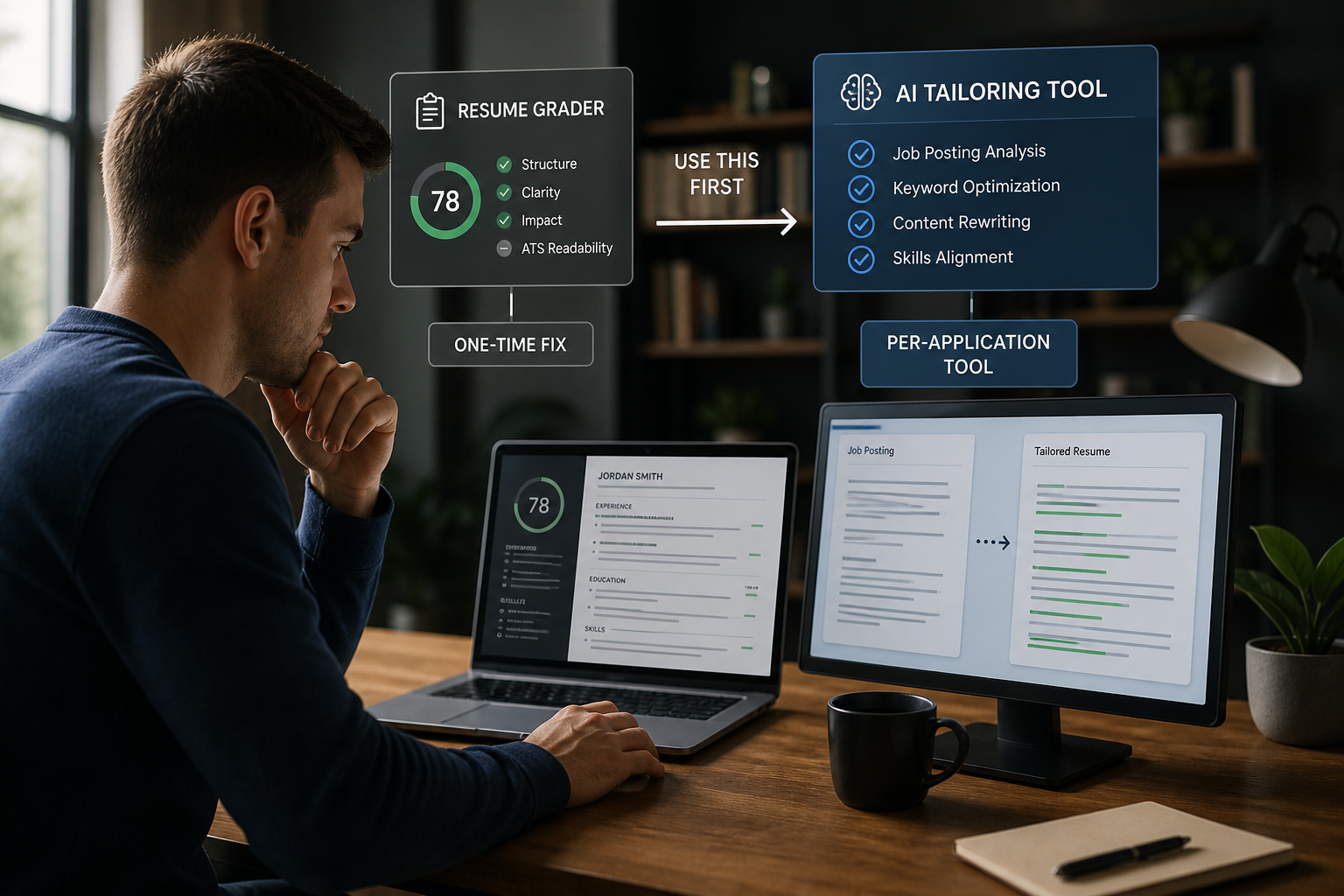
A resume grader scores your document in isolation and is a one-time fix. A tailoring engine rewrites that document against a specific posting and is a per-application tool. Use the grader first, then tailor.
Resume Worded is a resume grader: it scores your resume on its own merits and lists fixes. It is accurate about writing quality — quantified bullets, weak verbs, filler — and it is blind to the job you are applying to. An AI tailoring tool does the opposite: it rewrites your resume against one specific posting. Most people need the grader once and the tailoring every application.
What a grader does well
Feed a grader your resume and it evaluates the document in isolation:
- Are bullets written as accomplishments or as duties?
- Are results quantified?
- Are verbs varied and strong?
- Is the formatting parseable?
- Is there filler ("responsible for", "team player") crowding out substance?
This is genuinely useful, and it is a one-time fix. Your bullets either quantify results or they don't; that is not a per-application question. Run a grader once, fix what it flags, and you have a solid base resume.
Where a grader stops
A grader has no idea what job you are applying to. It cannot tell you that this posting cares about vendor management and yours leads with team size, or that the role is 70% forecasting and your forecasting work is buried in the third bullet of your second job.
That gap is the entire job search. Two candidates with equally well-written resumes get different outcomes based on which one reordered and reframed their experience to match the posting.
What a tailoring engine does
A tailoring engine takes two inputs — your career history and a job description — and produces a version of your resume aimed at that posting:
- Experience ordered so the most relevant work reads first
- The posting's own vocabulary worked into real accomplishments rather than appended to a skills list
- Weak or generic sections rewritten
- The result scored for ATS readability, human authenticity, role fit, and overclaim risk, then refined until those hold — see what a good ATS score actually means for what those numbers can and cannot tell you
The overclaim check matters more than people expect. The failure mode of AI resume writing is quiet inflation — "led" where you contributed, "owned" where you supported. A tailoring pass that does not check for that will eventually put a sentence in front of an interviewer that you cannot defend.
Cost and effort compared
| Resume grader | Tailoring engine | |
|---|---|---|
| Input | Your resume | Your resume + the job posting |
| Output | A score and a fix list | A rewritten, job-specific resume |
| How often you run it | Once, or after a big career change | Every application |
| Work left for you | Do all the rewriting | Review and approve |
| Best for | A weak base resume | A good resume that isn't landing interviews |
The honest recommendation
Use both, in order. Run a grader once so your underlying material is strong — a tailoring engine can only reorganize and reframe what you give it, so garbage in still means garbage out. Then tailor per application.
If you only pay for one and your bullets already have numbers in them, tailoring is where the marginal callback comes from. If your resume still says "responsible for daily operations", fix that first — free graders will tell you so at no cost.
Trying it
Our ATS resume checker covers the scan side and how it works walks through the tailoring flow end to end. The free plan is enough to see the difference on a single job posting; pricing covers what the paid tiers add. If you're still deciding between categories of tool, Jobscan alternatives maps the whole landscape.
Related comparisons: Teal vs. Kickresume vs. AskResumePro, the resume builders people are actually using in 2026, and how to pick a resume tool. If cost is the sticking point, what a resume service costs puts the numbers side by side and pricing shows ours.
Frequently Asked Questions
Can AI tailoring replace a resume grader?
Partly. A tailoring pass improves the sections it rewrites, but a dedicated grading pass on your base resume is still the cheapest way to fix habits like unquantified bullets that affect every version you produce.
Will an AI-tailored resume sound generic?
It can, if the tool only pattern-matches keywords. Look for a tool that scores human authenticity and rewrites sections that read as machine-generated, and always read the output before you send it.
How do I avoid exaggerating with AI?
Use a tool that explicitly checks for overclaiming, and reject any bullet you could not defend in detail for ten minutes in an interview.
Is Resume Worded's ATS score accurate?
It is an accurate read on writing quality and formatting, and it is not the score an employer sees. No third-party tool has access to the applicant tracking system a company runs, so treat any score as a self-check you compare against your own earlier versions, never as the employer's verdict.
Do I need both a resume grader and a tailoring tool?
Run a grader once so the underlying bullets are strong, then tailor per application. A tailoring engine can only reorganize and reframe the material you give it, so fixing a weak base resume first makes every tailored version better.
Related articles
Resume Tools
Best Resume Builder of 2026? What People Are Actually Using Now
The best resume builder in 2026 is not just a template tool. See what job seekers actually use to create ATS-ready resumes faster.
Resume Tools
Jobscan Alternatives in 2026: What to Use Instead
Jobscan popularized the resume match score. Here is how the main alternatives compare in 2026, and how to pick the one that matches how you actually apply.
Resume Tools
Teal vs. Kickresume vs. AskResumePro: Honest Comparison
Three tools, three different problems: pipeline tracking, document design, and per-job tailoring. Here is which one matches your actual bottleneck.